|
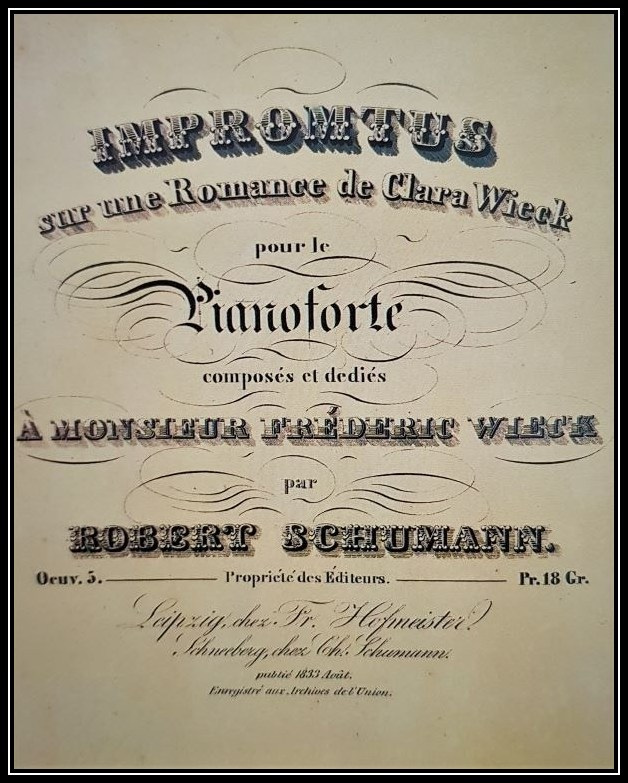
| Schumann never forgot his debt to his first piano teacher and dedicated his Impromptus to him. |
Robert Schumann (1810–1856) was one of the composers who fundamentally shaped the musical identity of Romanticism. In his music, literature, poetry, memory, and personal experience are not merely external sources of inspiration; they often determine the very way musical thought is organized. Small motifs acquire narrative significance, short pieces become connected within larger cycles, and contrasting characters seem to converse within the same composition.
His creative path is marked by striking periods of concentration on particular genres. During the 1830s, the piano stood almost exclusively at the center of his work; 1840 brought the extraordinary flowering of the Lied, 1841 a systematic turn toward symphonic music, and 1842 an intense engagement with chamber music. Despite these changes, one essential feature remained constant: Schumann’s desire to combine rigorous musical construction with the freedom of poetic imagination.
Symphonies and Symphonic Music
- Symphony No. 1 in B-flat major, “Spring”, Op. 38 — Written in early 1841 and premiered in Leipzig under Felix Mendelssohn, it marked Schumann’s decisive entry into symphonic composition. Its pulsating rhythmic energy, bright orchestration, and thematic relationships between movements bring something of the vitality and immediacy of his piano cycles into the large orchestral form.
- Symphony No. 2 in C major, Op. 61 — Composed primarily in 1845–46, it belongs among Schumann’s most densely organized symphonic works. Contrapuntal writing, references to the tradition of Bach, and the recurrence of fundamental motivic ideas give the four movements strong internal unity. Beneath the brilliance of C major, a more complex and introspective expressive world frequently emerges.
- Symphony No. 3 in E-flat major, “Rhenish”, Op. 97 — The last symphony Schumann composed, in 1850, has an unusual five-movement design. Its broad rhythmic motion, successive changes of atmosphere, and the imposing, almost ceremonial gravity of the fourth movement create a symphonic image closely connected with the landscape and experience of the Rhineland without turning the work into a literal programmatic narrative.
- Symphony No. 4 in D minor, Op. 120 — Its first version was completed as early as 1841, but Schumann returned to the work ten years later and revised it extensively. The four movements pass into one another without substantial interruption, while thematic ideas reappear in transformed forms. The symphony consequently takes on the character of a single dramatic journey and represents one of the boldest experiments in cyclic organization in nineteenth-century symphonic music.
- Ouverture, Scherzo und Finale, Op. 52 — This three-part orchestral work of 1841 stands between the symphony and the symphonic suite. Without a slow movement and with particularly concentrated writing, it presents a lighter and more flexible side of Schumann’s orchestral thought while retaining the thematic coherence that characterizes his larger symphonic works.
Concertos and Works for Soloist and Orchestra
- Piano Concerto in A minor, Op. 54 — The first movement was created in 1841 as an independent Phantasie for piano and orchestra, while the complete concerto was finished in 1845. Schumann moves away from the idea of the concerto as a field of opposition between the virtuoso soloist and the orchestra. The piano is integrated into the orchestral texture, and thematic material continually passes from one to the other, creating a relationship of sustained dialogue.
- Cello Concerto in A minor, Op. 129 — Written in 1850, it organizes its three movements as a continuous flow and systematically avoids conventional virtuoso display. The cello functions primarily as a lyrical, flexible voice developing within the orchestral texture. The work’s internal economy and absence of demonstrative brilliance distinguish it markedly from many concertos of its period.
- Konzertstück for Four Horns and Orchestra in F major, Op. 86 — A work of exceptional technical demands and unusual sonic conception. Schumann exploits the expanded possibilities of the valved horn, by then increasingly established in the nineteenth-century orchestra, and treats the four solo instruments at times as a single brilliant body and at others as four independent voices.
- Violin Concerto in D minor, WoO 1 — Written in 1853 for Joseph Joachim, it belongs to Schumann’s last major works. It was not published during his lifetime and remained outside public performance for more than eight decades, until its premiere in 1937. This unusual history of reception contributed for many years to the distinctive and often controversial reputation surrounding the work.
Chamber Music
- Three String Quartets, Op. 41 Nos. 1–3 — Composed during the summer of 1842 and dedicated to Mendelssohn. Schumann’s intensive study of the quartets of Haydn, Mozart, and Beethoven lies behind them, yet he does not simply revive the Classical tradition. He transforms it through his own harmonic language, dense motivic development, and sudden changes of character.
- Piano Quintet in E-flat major, Op. 44 — A work that played a decisive role in establishing the combination of piano and string quartet as a major Romantic ensemble. The extrovert energy of the opening movement, the measured funeral march of the second, the mobility of the Scherzo, and the contrapuntal construction of the finale create a large-scale form in which piano and strings collaborate without losing their individual identities.
- Piano Quartet in E-flat major, Op. 47 — Closely related in date to the Quintet, but more introspective in character and sonic balance. The lyrical Andante cantabile, with its distinctive cello line, forms the expressive core of a work in which the piano is integrated with remarkable naturalness into the string texture.
- Piano Trio No. 1 in D minor, Op. 63 — Written in 1847, it possesses a strong dramatic direction and dense interaction among the three instruments. Thematic ideas pass from one voice to another, while frequent harmonic shifts create a more concentrated and unsettled world than that of the major chamber works of 1842.
- Fantasiestücke for Clarinet and Piano, Op. 73 — Three short pieces from 1849 linked into a gradually intensifying dramatic trajectory. Within a limited span, Schumann achieves substantial changes of character and dynamics. The score also permits performance with violin or cello in place of the clarinet.
- Three Romances for Oboe and Piano, Op. 94 — One of the principal Romantic cycles for oboe. The melodic line often possesses an almost vocal quality, while the piano does not remain in an accompanying role but actively participates in shaping the harmonic and expressive course.
- Violin Sonata No. 1 in A minor, Op. 105 — Composed in 1851 and characterized by a compact three-movement design, strong rhythmic energy, and dramatic concentration. Violin and piano are treated as equal voices, with thematic material continually transferred and transformed between them.
Piano Music
- Papillons, Op. 2 — One of the earliest compositions in which Schumann’s distinctive poetic world clearly emerges. A succession of short dances and episodes creates the impression of a masquerade scene, while the profound influence of Jean Paul’s literature lies behind the music.
- Davidsbündlertänze, Op. 6 — Eighteen pieces in which the impetuous Florestan and the introspective Eusebius meet symbolically, the two imaginary personalities through whom Schumann expressed contrasting aspects of his artistic self. Their opposition runs throughout the entire cycle and becomes a fundamental principle of its musical organization.
- Carnaval, Op. 9 — A succession of brief musical portraits and scenes in which characters from the commedia dell’arte, Florestan and Eusebius, figures from Schumann’s real surroundings, and musical cryptograms coexist. Unity does not arise from a conventional large-scale form but from the recurrence of motifs, characters, and symbolic associations.
- Fantasiestücke, Op. 12 — Eight pieces with poetic titles, ranging from the calm Des Abends to the turbulent In der Nacht. The collection reveals Schumann’s ability to turn the small piano form into a space for dramatic and psychological narrative without requiring an external program.
- Symphonic Etudes, Op. 13 — A work situated between variation, étude, and large-scale cyclic composition. The original theme undergoes continual rhythmic, harmonic, and stylistic transformations, while the density of the piano writing often creates the impression of a much broader, almost orchestral sound world.
- Kinderszenen (Scenes from Childhood), Op. 15 — Thirteen short compositions written not as pedagogical music for children but as poetic recollections of childhood experience viewed through adult eyes. The celebrated Träumerei, No. 7 is a characteristic example of Schumann’s ability to create extraordinary expressive density with extremely limited means.
- Kreisleriana, Op. 16 — Inspired by Johannes Kreisler, the eccentric musician of E.T.A. Hoffmann, the collection moves with unusual speed between agitation and introspection. Contrasts of tempo, texture, and dynamics are so pronounced that the cycle seems to portray a continual alternation of different psychological states.
- Fantasy in C major, Op. 17 — One of Schumann’s most extensive and demanding piano compositions. Its original conception was connected with efforts to raise funds for the Beethoven monument in Bonn, but the finished work goes far beyond that starting point. The freedom of fantasy is combined with strong thematic relationships and a deeply personal, confessional dimension.
- Album für die Jugend (Album for the Young), Op. 68 — Here pedagogical purpose meets artistic economy. The opening pieces are comparatively simple and accessible, while technical and expressive demands gradually increase. Without abandoning clarity of writing, Schumann creates a rich world of characters, images, and miniature narrative moments.
- Waldszenen (Forest Scenes), Op. 82 — Nine piano images in which the forest appears by turns familiar and idyllic, enigmatic and threatening. The celebrated Vogel als Prophet stands out for its unusual harmonic language and for the suggestive way in which the melody seems to imply rather than fully complete its phrases.
Lieder and Song Cycles
- Liederkreis, Op. 24 — A cycle of nine songs on poetry by Heinrich Heine, written in early 1840. Romantic expectation, disappointment, and the ironic distance of the poetic text are translated into music through continuous interaction between the vocal line and the piano.
- Myrthen, Op. 25 — A collection of twenty-six songs on poems by several writers, dedicated by Schumann to Clara Wieck as a wedding gift. The title refers to the myrtle blossom, a traditional symbol of marriage, and the alternation of poets and musical characters creates a distinctive lyrical wreath around the idea of love.
- Zwölf Gedichte von Justinus Kerner, Op. 35 — Twelve songs on poetry by Justinus Kerner in which nature, wandering, solitude, and inward searching combine to form an unusually coherent expressive world. The piano often continues after the vocal phrase has ended, giving musical form to what the poem leaves suspended.
- Liederkreis, Op. 39 — Twelve songs on poems by Joseph von Eichendorff. Night, forest, distance, travel, memory, and expectation return through different poetic images, forming one of the most characteristic worlds of German Romanticism.
- Frauenliebe und Leben, Op. 42 — Eight songs on poetry by Adelbert von Chamisso, organized as a continuous narrative journey. The piano acquires particular significance at the end of the cycle, when the voice falls silent and the musical material from the beginning returns, closing the narrative with an extended instrumental remembrance.
- Dichterliebe, Op. 48 — Sixteen songs on poems by Heinrich Heine and a defining example of Schumann’s conception of the Lied. Voice and piano do not function simply as melody and accompaniment but as two distinct carriers of the narrative. The vocal line often ends before the emotional meaning is fully resolved, leaving the piano to continue it, illuminate it differently, or even undermine it.
Large-Scale Vocal, Dramatic, and Stage Works
- Das Paradies und die Peri, Op. 50 — A large-scale work for soloists, chorus, and orchestra, based on an episode from Thomas Moore’s Lalla Rookh and completed in 1843. Its continuous narrative flow, imaginative choral writing, and rich orchestral color contributed to the considerable success the work enjoyed during Schumann’s own lifetime.
- Genoveva, Op. 81 — Schumann’s only completed opera, composed mainly in 1847–48 and premiered in Leipzig in 1850. Its continuous musical flow, limited use of conventional closed numbers, and emphasis on the psychological changes of the characters reveal his ambition to develop a personal model of Romantic music drama.
- Manfred, Op. 115 — Incidental music for Lord Byron’s dramatic poem, written in 1848–49. From its opening chords, the celebrated Overture condenses the hero’s unrest, guilt, and inner conflict. Although the complete incidental music is heard less frequently, the Overture has maintained a secure place in the symphonic repertoire.
- Szenen aus Goethes Faust (Scenes from Goethe’s Faust), WoO 3 — A work that occupied Schumann in different phases from 1844 to 1853 and does not fit easily into a conventional category. Rather than setting the entire drama, he selected particular scenes from both parts of Faust, gradually constructing a large-scale work centered on human desire, downfall, redemption, and transcendence.
In Schumann’s music, the distinction between the “small” and the “large” form often loses much of its significance. The same ability that allows a few measures of a Lied or a piano miniature to acquire a complete psychological character also lies behind his symphonies, concertos, and chamber music. From Carnaval and Dichterliebe to the Piano Quintet and the “Rhenish” Symphony, different genres ultimately serve a common search: the transformation of memory, poetry, imagination, and human experience into purely musical form.