 |
| Shivering, fireside shelter and uncertain steps on ice acquire different rhythms and textures in Winter. |
Work Information
- Composer:
- Antonio Vivaldi (1678–1741)
- Title:
- Winter (L’inverno), in F minor, Op. 8 No. 4, RV 297; fourth concerto of The Four Seasons
- Year of composition:
- Before publication in 1725; the exact date remains uncertain
- First performance:
- Not securely documented
- First publication:
- Amsterdam, Michel-Charles Le Cène, 1725; within Il cimento dell’armonia e dell’inventione, Op. 8
- Genre:
- Programmatic violin concerto
- Musical Period:
- Baroque
- Structure:
- Three movements: Allegro non molto · Largo · Allegro
- Duration:
- approx. 8–10 minutes, depending on the performance
- Instrumentation:
- Solo violin, violins I and II, viola and basso continuo
Antonio Vivaldi’s Winter, Op. 8 No. 4, RV 297, closes The Four Seasons with a concerto in F minor for solo violin, strings and basso continuo. Its subjects are immediately recognisable physical experiences: shivering, stamping the feet, chattering teeth and the effort to keep one’s balance on ice. Between the fast outer movements, the Largo places a singing violin melody beside the sound of rain, bringing the comfort of the fireside and the weather outside into the same musical space.
Much of the concerto’s immediacy comes from the precision with which these experiences are distinguished. The opening repetitions, the soloist’s rushing passages and the finale’s sliding figures involve different rhythms, articulations and relationships with the accompaniment. Their contrasts can be heard before the poem is read. The score’s verbal directions then attach particular actions to particular passages.
Winter appeared in Amsterdam in 1725, published by Michel-Charles Le Cène within Il cimento dell’armonia e dell’inventione. Its exact date of composition and first performance remain uncertain. Publication provides a secure historical landmark; reconstructing the concertos’ earlier development requires a more careful distinction between surviving sources. The collection’s history, its dedication to Count Morzin and its overall design are discussed in the Work Guide to The Four Seasons.
The accompanying sonnet is anonymous. Attribution to Vivaldi is familiar but unproven. Reference letters and brief captions connect the poetry with the instrumental parts, allowing the descriptive sequence to be followed in detail. This analysis follows the printed tradition, checked against the first edition and the later transcription. The Manchester manuscript parts offer alternative readings that matter particularly for articulation and the distribution of the accompaniment.
The sonnet’s last line gives the whole concerto another perspective: winter also brings delight. Vivaldi ends in F minor, with vigorous activity and a firm cadence. The poem invites us to hear the season across a range of experiences, from discomfort and danger to the pleasure of shelter and the exhilarating energy of the final encounter with the winds.
Movements / Structure
The F minor outer movements surround a Largo in E-flat major, where both tone colour and the accompaniment’s function change. The first two movements share common time, although their experience of duration is very different. The finale’s 3/8 establishes short units of motion that can be extended into much longer phrases.
| Movement / Tempo | Key / Metre | Character and function |
|---|---|---|
| I. Allegro non molto | F minor 4/4 | Successive entries establish the opening shiver. Wind, stamping feet and chattering teeth acquire different textures within the solo–ensemble exchange. |
| II. Largo | E-flat major 4/4 | A singing melody above pizzicato rain, sustained viola and moving bass. Their contrast establishes the experience of shelter. |
| III. Allegro | F minor 3/8 | Walking, slipping and breaking ice. Sirocco appears in a Lento before the winds’ rapid concluding battle. |
The fast–slow–fast arrangement corresponds to three changing relationships with the environment: reacting to cold, enjoying protection from it and negotiating the ice. Within the finale, a separate Lento introduces another contrast before the winds engage in battle. The ending emerges through successive transformations rather than an uninterrupted increase in speed.
The other concerto analyses: Spring, RV 269 · Summer, RV 315 · Autumn, RV 293.
The accompanying sonnet
This free English rendering follows the Italian poem’s fourteen lines: four belong to the first movement, two to the Largo and eight to the finale. Its sequence specifies a series of actions without requiring one individual to remain the protagonist throughout the concerto.
I. Allegro non molto
Shivering with cold among the frozen snows,
beneath a terrible wind’s biting breath;
running, stamping the feet again and again,
the teeth chattering in the bitter frost.
II. Largo
Enjoying peaceful, happy days beside the fire,
as the rain outdoors soaks so many others.
III. Allegro
Walking on the ice with measured steps,
taking care for fear of a fall;
moving quickly, slipping, tumbling to the ground,
venturing onto the ice once more and running hard,
until the frozen surface splits apart;
hearing the rush from iron-bound gates
of Sirocco, Boreas and every wind at war.
Such is winter, and such a winter brings delight.
Musical Analysis
I. Allegro non molto — Shivering and the body’s changing responses
The concerto begins with a regular pulse of quavers in the bass. The viola enters in the second bar, the second violins in the third, and the first violins together with the soloist in the fourth. These entries are precisely coordinated. Their accumulation nevertheless makes the shiver seem to spread through the ensemble. The caption Aggiacciato tremar trà nevi algenti identifies trembling in the icy snow.
Example 1 makes the process visible: rests precede each entrance, after which the parts share the quaver pulse. Trills appear in the uppermost line. Repeated attacks, short slurs and articulation marks divide the sound into small units. The opening’s severity arises from this particular organisation, with F minor supplying its tonal setting.
| Example 1. Vivaldi, Winter, I. Allegro non molto, bars 1–5, without an upbeat. All parts: viola and violins join the initial quaver pulse. Mutopia Project, anonymous transcription, 2010, official preview from the full score, p. 1. Source · CC BY-SA 3.0. |
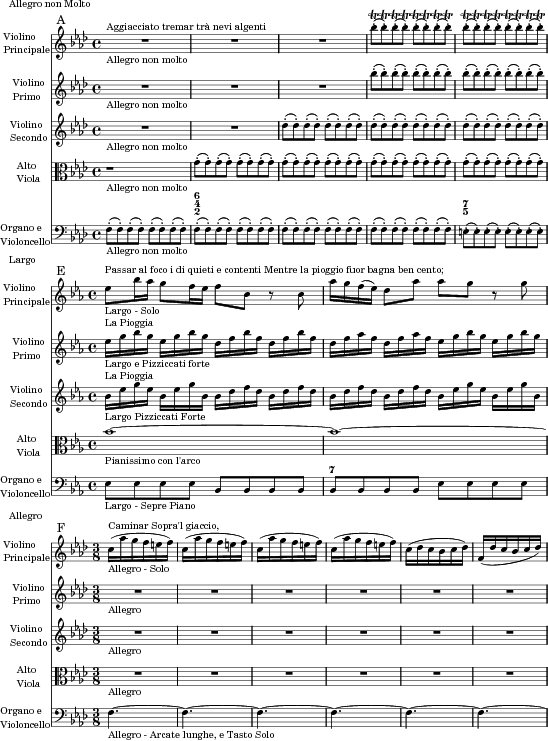
As more parts enter, the texture thickens and the relationships between their pitches change. Friction within the harmony is renewed by successive small movements. An expansive singing theme has yet to emerge, but the passage already has direction. Instrumental accumulation and harmonic change organise the listener’s expectation before the first conspicuous solo episode.
At Solo, the violin introduces the terrible wind, Orrido vento. Rapid descents and sequences of short notes replace the opening’s restricted repetitions. Brief orchestral answers alternate with silences, leaving room for the soloist’s changes of direction. The difference is easy to hear: motion now traverses a broader range instead of repeatedly articulating a narrow band of pitches.
The opening material continues to matter. Returning between solo regions, either more fully or in shorter portions, it performs the function of a ritornello: recognisable ensemble music that supplies points of return. These reappearances connect the different bodily responses within a larger formal course. Description develops through an organised exchange between the soloist and the orchestra.
Batter li piedi per il freddo, stamping the feet because of the cold, brings more emphatic rhythmic units. The bass has particular weight within the coordinated attacks. Compared with the initial shiver, the activity feels more purposeful: running and stamping are attempts to keep warm. The instrumental pulse makes that change intelligible without requiring a literal musical equivalent for every footstep.
Longer solo passages follow, developing patterns at different pitches and bringing back the wind. Successive descents and changes in harmonic support maintain the pressure. Virtuosity serves a specific dramatic function here. The soloist’s activity expands in range and continuity, while orchestral re-entries restore a shared rhythmic foundation.
The caption Battere i denti specifies chattering teeth. Rapid repetitions in the solo violin are now written as double stops. Two pitches sounding together, repeatedly and in quick succession, produce a different texture from the single-line trills heard near the beginning. Related images of cold acquire distinct instrumental treatment.
The final orchestral passage gathers the ensemble’s energy towards a cadence in F minor. A concluding fermata arrests music that has become intensely active. Cold has been established through changing relationships between speed, articulation and density. The next movement will alter all three at once.
II. Largo — A fireside melody beside the violin rain
The Largo moves into E-flat major. Common time remains, but the slower pace gives the melody another kind of freedom. The solo violin begins immediately, combining steps, small leaps and ornamental figures within a sustained line. Short note values now contribute to an unfolding song, acquiring a different character from the wind’s hurried motion.
The sonnet places the human figure beside the fire while rain falls outside. La pioggia belongs to the first and second violins, playing continuous semiquavers pizzicato. Plucking the strings replaces the sustained action of a bow with a succession of brief sounds. Their rapid renewal creates a separate layer of activity around the melody.
The viola continues with the bow, holding long notes, while the bass proceeds in quavers. Several forms of accompaniment therefore coexist: quick plucked figures, sustained sound and a slower-moving lower line. Their independence helps explain why the scene remains active during the soloist’s brief pauses for breath.
Example 2 shows this arrangement in the first two bars. Its contrasting directions deserve particular attention: Pizzicati forte in the violins, Pianissimo con l’arco in the viola and Sempre piano in the bass. The rain is meant to have a clearly audible presence. The plucked notes’ short duration and the balance between the parts allow a firm attack to remain distinct from the melody’s continuous sound.
| Example 2. Vivaldi, Winter, II. Largo, bars 1–2, without an upbeat. All parts, showing different dynamics and methods of sound production. Mutopia Project, anonymous transcription, 2010, official preview from the full score, p. 11. Source · CC BY-SA 3.0. |
The movement’s tranquillity consequently depends on more than a uniformly soft dynamic. The violins, viola and bass have different instructions and different means of producing sound. A comfortable melody and the external weather are heard simultaneously, their functions kept clear through that differentiation. Hearing the rain is part of what makes the shelter perceptible.
Within the melody, rests, ornaments and changes of direction give individual phrases their shape. A brief silence in the upper line exposes the rain and bass more clearly. When the violin resumes, the accompaniment has already preserved time and harmonic continuity. Attention can move naturally between the soloist and the other voices without losing the movement’s progress.
The harmony leaves its initial stability and finds its way back to E-flat major through directed motion and clear cadences. Changes are audible in the bass beneath the persistent pizzicatos. Repeating one rhythmic value does not imply repeating one harmony. The evolving lower line supports the violin’s song while preserving its own steady kind of movement.
In the printed source, the bass part is headed Organo e Violoncello. The Manchester manuscript separates the cello from a part for harpsichord and violone, the low string instrument of the continuo group. A single bass staff in a full score should therefore not be understood as an instruction for every available player to perform continuously at equal strength. Source choice and the allocation of the accompaniment affect the movement’s sound.
The final cadence briefly holds this balance of melody and accompaniment before the finale begins. Autumn’s sleeping scene used long note values and harpsichord arpeggios. Here, a peaceful human experience coexists with quick, measured plucking. Comparing the two reveals different ways of constructing a slow movement within the same cycle.
III. Allegro — Cautious steps, a fall and contrasting winds
The finale returns to F minor in 3/8, with the solo violin active from the first bar. A small semiquaver figure repeats over a prolonged bass foundation. The orchestral violins and viola are silent, leaving the soloist’s relationship with the sustained lower sound unusually exposed.
Caminar sopra ’l ghiaccio identifies walking on the ice. Small recurring contours and the bass’s relative immobility give the opening its restrained quality. Notes are already moving quickly within each bar. Caution is conveyed chiefly through the way the music revisits the same limited pattern before venturing further.
The bass direction Arcate lunghe e Tasto solo calls for long bow strokes and a single line without added chords. This is a significant alternative to a fuller continuo realisation. At the beginning of the movement, an exposed low pitch supplies support while the violin’s small movements remain in the foreground.
The ensemble’s entrance enlarges the scene and changes the articulation. Short, separated phrases accompany Caminar piano e con timore, walking carefully and fearfully. Solo and tutti present different aspects of the same activity. Even within this closely specified description, the concerto preserves a dialogue between an individual voice and the larger group.
At Gir forte, sdrucciolar, cader a terra, more forceful motion and descending lines identify slipping and falling. Parts can move together before yielding again to the violin. The verbal caption establishes the passage’s particular meaning: a quick descent on its own can fulfil many functions in Vivaldi’s music.
The poem then returns to venturing onto the ice and running. Di nuovo sopra ’l ghiaccio e correr forte accompanies more extended solo activity, while the accompaniment changes density again. The movement does not simply progress from long notes towards short ones. Figures that were already quick develop over a wider range, with different support and greater continuity.
When the ice breaks, abrupt changes and brief silences interrupt the ongoing motion. Il ghiaccio si rompe e si disserra identifies the event. A listener can follow the shift from recurring patterns towards disrupted activity without treating the score as a detailed account of every physical consequence of the break.
Before the winds’ final battle comes a distinct Sirocco passage marked Lento. The tempo slows, the upper strings adopt calmer, connected phrases and the bass falls silent. Removing the lower foundation changes the weight of the sound. The sequence of winds has its own internal contrast, with this lighter passage preceding the later force.
Boreas and the other winds follow through renewed rapid solo writing and successive orchestral interventions. Repeated pitches and descending figures spread across more parts. The returning bass joins the activity, restoring a foundation that had been absent during the Lento.
Short note values and coordinated cadential motion finally converge on F minor. The sonnet ends by acknowledging winter’s delight, a word that coexists with the music’s continuing intensity and minor tonality. A decisive cadence completes the experience without requiring an additional scene of fine weather.
The body as a musical subject
Shivering and slipping are different experiences. In the opening movement, motion repeats while the human figure may remain almost stationary. In the finale, movement involves an unstable surface. Vivaldi distinguishes these conditions through the relationship between a repeated pitch, a melodic contour and the support provided by the bass.
Articulation is crucial. The opening’s short units feel different from the soloist’s connected patterns on the ice. Long bass notes allow a small figure to be heard several times above relative stability. An added orchestral part or an interruption in the accompaniment changes the conditions surrounding that figure. Its effect depends on how it is supported as much as on the shape of the line itself.
The soloist also changes descriptive identity. In the first Allegro, the violin’s line takes on the wind as well as human reactions to cold. In the finale, it presents different actions and joins the ensemble’s concluding activity. Its range of descriptive possibilities comes from the ability to change speed, register, articulation and its relationship with the other voices rapidly.
Captions and poetry provide orientation, but recognising an image begins rather than completes the listening process. The same technique can serve several scenes: repetition becomes shivering, chattering teeth or the wind’s pressure. Meaning emerges through instrumental distribution, context and the memory of what has already been heard.
Listening from a different distance
In the Largo, rain remains present while the human figure enjoys the fireside. Different musical layers create a sense of interior and exterior space. The solo melody draws attention through its continuing phrase, while the plucked violins keep the surrounding weather audible.
Performance must preserve both functions. Pizzicatos that retreat too far weaken the external scene; those that cover the soloist make its contrasting ease harder to follow. Written dynamics and different methods of sound production provide the framework. The perceived distance between the layers is established by the players’ actual balance.
These changing positions also help explain the concerto’s pleasure. The opening shiver feels immediate; rain is heard from shelter; the final winds acquire an energy that can be followed from the listener’s safe distance. The last line’s delight can belong to this variety of relationships with the season. It need not depend exclusively on major harmony or on a low dynamic.
🪶 A Chapter in the Life of the Work
From the snow to the stage of Farnace
On 10 February 1727, Venice’s Teatro Sant’Angelo presented Vivaldi’s Farnace, to a libretto by Antonio Maria Lucchini. Further productions followed. In the spring of 1731, at Pavia’s Teatro Omodeo, Vivaldi adapted the opera for another company. The king Farnace would now be sung by the tenor Antonio Barbieri.
For Barbieri, Vivaldi revised Gelido in ogni vena, an aria with words by Metastasio previously used in his Siroe of 1727. It gave the singer an intensely emotional scene. Within the music was something familiar from Winter: repeated notes and accumulating string entries associated there with trembling in the cold.
In the opera’s story, the defeated Farnace has ordered his wife Tamiri to kill their son and then herself, to spare them captivity. Tamiri saves the child, hiding him in the royal mausoleum. Farnace believes him dead. When his wife says that their son is in the tomb, he takes her words as confirmation that his order has been carried out.
Gelido in ogni vena begins within that misunderstanding. The father feels his blood run cold and is terrified by the thought of his dead son. His words describe fear and guilt, while the strings maintain their insistent, measured activity. The bodily reaction associated with snow in the concerto now accompanies a person who believes he has caused an irreversible loss.
The aria does not transfer Winter’s whole first movement to the stage. A slower pace, dynamic contrasts and the vocal line create another musical course. The recognisable shiver becomes part of new phrases and acquires a relationship with specific words. Before the first sung entry, the instruments have prepared the condition of the character about to speak.
By the opera’s end, the misunderstanding is resolved: the child is alive, and the conflict moves towards reconciliation. The aria retains the intensity of the moment when the father does not know the truth. Its reuse also changes our hearing of Winter. Vivaldi had devised a figure capable of expressing a shiver; he could associate it both with physical cold and with a dramatic character’s fear.
🎧 Listening Guide
On a first hearing, follow the change from repetition to song and then to the finale’s continual transformations. On another, listen to the parts supporting the solo violin.
The accumulating entries. Hear the bass first, then the addition of viola and violins. A shared pulse remains in place as the sound grows denser.
The soloist’s wind. Distinguish the rushing descents from the opening repeated quavers. Follow the orchestra’s brief replies and silences around the violin.
Feet and teeth. Compare the emphatic coordinated attacks associated with stamping feet against the rapid double stops of chattering teeth. Repetition has a different weight in each texture.
The Largo’s layers. Follow the solo melody, quick pizzicatos, sustained viola notes and bass quavers separately. Notice which part becomes clearer when the melody briefly pauses.
Support on the ice. At the finale’s beginning, hear how little the low foundation moves beneath the violin. Then locate the ensemble entrance and the change in articulation.
Sirocco before Boreas. Find the Lento and the missing bass. The return of rapid figures and the lower line gains force after this change.
The closing cadence. Keep the sonnet’s last line in mind and hear the music reach completion within the active motion of F minor.
🎶 Further Listening
These four choices allow comparisons of ensemble scale, repeated-note articulation and balance. Try hearing the same passage in succession: the Largo’s opening, for example, or the transition from Sirocco to the other winds.
- Cynthia Miller Freivogel — Voices of Music, Winter / L’inverno, RV 297: the period-instrument performance embedded in this article. Watching helps connect pizzicato sound, different bowing actions and the players’ successive entries with what is heard.
- Giuliano Carmignola — Venice Baroque Orchestra — Andrea Marcon, The Four Seasons, Sony Classical: useful for comparing the strong contrasts between solo activity and orchestral interventions. Concentrate on how the brief phrases are shaped in the fast movements.
- Rachel Podger — Brecon Baroque, Le quattro stagioni, Channel Classics CCS SA 40318, 2018: a small-ensemble approach well suited to following inner voices. In the Largo, compare the viola and lower accompaniment’s presence against the solo melody.
- Itzhak Perlman — London Philharmonic Orchestra, The Four Seasons, EMI / Warner Classics: offers a different comparison in the body of sound and continuity of solo phrasing. Hear how the same writing is projected on a larger orchestral scale.
📚 Further Reading
Winter rewards an approach that brings its musical images together with source study, harmony and instrumental texture.
- Paul Everett — Vivaldi: The Four Seasons and Other Concertos, Op. 8 (1996): a specialised continuation for the sources and formal organisation of the collection, closely grounded in the music itself.
- Michael Talbot — Vivaldi, revised edition, Oxford University Press, 2000: places the concertos within the composer’s instrumental and theatrical activity, a valuable perspective on Winter’s relationship with opera.
- Bella Brover-Lubovsky — Tonal Space in the Music of Antonio Vivaldi (2008): develops questions of tonal design and harmonic direction beyond familiar generalisations about major and minor keys.
- Nicholas Lockey — Antonio Vivaldi and the Sublime Seasons: Sonority and Texture as Expressive Devices in Early Eighteenth-Century Italian Music (2017): examines the expressive role of sonority and texture, especially relevant to the strings’ changing distribution.
🔗 Related Works
These works extend particular questions raised by the concerto: how trembling can be represented, how a musical idea changes when words are added, and how winter experience can be organised through other resources.
- Antonio Vivaldi — Gelido in ogni vena, from Farnace, RV 711, Pavia version, 1731: the transfer of first-movement material to a vocal scene allows a direct comparison between physical cold and the expression of fear and guilt.
- Antonio Vivaldi — Il riposo – Per il Santissimo Natale, Violin Concerto in E major, RV 270: offers another approach to repose within a winter festive setting. Comparison with the Largo shows how differently the strings can function in a gentle scene.
- Henry Purcell — King Arthur, Z. 628, Act III, What power art thou: the Cold Genius scene connects trembling with voice and strings. It provides a useful comparison of repetition’s descriptive function, without presupposing a direct influence on Vivaldi.
- Joseph Haydn — The Seasons (Die Jahreszeiten), Hob. XXI:3, Winter: seasonal weather and human activity unfold through soloists, chorus and orchestra. Sung words substantially change the relationship between narrative and musical description.
🎼 Closing Reflection
In the Largo, follow only the rain for a while. Once the ear has settled into the quick plucked notes, return to the violin without losing the accompaniment. A single moment contains two experiences of time. The melody can feel restful while movement continues around it; what has changed is the position from which we listen.
📖 Bibliography and Sources
This account checks descriptive captions, note values, articulation and instrumental distribution against the first printed edition and the later transcription. The historical narrative brings together the 1731 production’s details, the dramatic text and the aria’s music. Events within the opera are distinguished from the history of its performances.
Scores and sonnet
Vivaldi, Antonio — Il cimento dell’armonia e dell’inventione, Op. 8 No. 4, L’inverno, RV 297. Amsterdam: Michel-Charles Le Cène, 1725, plate 520. First edition in separate parts; Bibliothèque nationale de France / IMSLP Nos. 310709–310713.
Vivaldi, Antonio — L’Inverno / Winter. Anonymous transcription, Mutopia Project, 2010, piece 351, based on Performers’ Facsimiles. Full score, IMSLP No. 11100, especially pp. 1, 11–13 and 18–22. Examples 1 and 2 are selected crops of the official preview image. Creative Commons Attribution-ShareAlike 3.0.
Anonymous — Sonetto dimostrativo for L’inverno, Op. 8. Italian text in the work’s source tradition and the preface to Hogwood’s edition; freely rendered into English for this article.
Hogwood, Christopher — Preface and editorial notes to Le quattro stagioni. Bärenreiter, BA 6994, 2000. Distinction between print and manuscript traditions, particularly the Largo’s continuo instruments.
The aria and its theatrical history
Vivaldi, Antonio — Farnace, RV 711, Pavia version, 1731: Gelido in ogni vena, Act II, scene 6. Manuscript source, SLUB Dresden, Mus.2389-I-1, digital excerpt IMSLP No. 380483. Later transcription by Oleg Dikansky, 2024, also referencing Torino, Giordano 36, IMSLP No. 940059.
Lucchini, Antonio Maria / Metastasio, Pietro — Dramatic text of Farnace and the aria Gelido in ogni vena, as reproduced in the Farnace programme, Fondazione Teatro La Fenice, 2021.
Borin, Alessandro — “Storia, tradizione e stile del Farnace”, in Farnace, Fondazione Teatro La Fenice, 2021, pp. 53–63, especially 59–61.
Università di Bologna — Corago, Farnace record APC0004705 and Pavia production record 0000404138; chronology, theatre and the 1731 libretto’s publication history.
Lednice-Valtice Music Festival — Programme Note: Il Farnace, 2021, Musica Florea production of the Pavia version. Version history and the aria’s relationship with Winter.
Recordings and comparisons
Voices of Music — Vivaldi Four Seasons: Winter (L’Inverno), original version, Cynthia Miller Freivogel; official video, ID ZPdk5GaIDjo. Sony Classical — Carmignola / Venice Baroque Orchestra / Marcon, The Four Seasons. Channel Classics — Podger / Brecon Baroque, Le quattro stagioni, CCS SA 40318, 2018. EMI / Warner Classics — Perlman / London Philharmonic Orchestra, The Four Seasons.
London Concert Choir — Purcell: King Arthur, discussion of the Frost Scene and its vocal and instrumental writing.